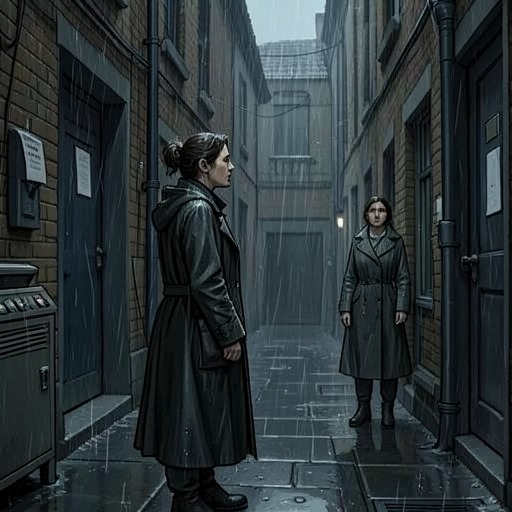
Elena seeks out Isabel and asks her to help investigate Rita's death
Elena KnowsElena’s search for Isabel turns a journey across Buenos Aires into a request for another person’s help: because Parkinson’s disease limits what Elena can do, she wants Isabel to provide the body and mobility she no longer has for investigating Rita’s death. The encounter does not produce the assistance she expects. Instead, it reveals that the women have carried incompatible understandings of a twenty-year-old debt—and ends with Isabel claiming a form of responsibility for Rita’s death while distinguishing it from the physical act that caused it.
Purpose and the need for another body
Elena sets out to find the one person she believes might agree to help her: Isabel, whom she has not seen for twenty years. She is prepared to invoke an old debt, although she remembers that Rita objected to treating obligations as exchanges. Elena nevertheless regards this debt as the reason to ask. If Isabel remembers Rita, Elena hopes, she may feel bound to respond; if she does not know that Rita has died, Elena will have to explain both the death and what little she herself understands about it.
The request arises from Elena’s conviction that Rita was murdered, despite the coroner, Inspector Avellaneda, and Roberto Almada treating the death as suicide. Elena cannot identify a motive or prove her belief independently. Her insistence that it was raining is decisive to her understanding of what happened, but she recognizes that this conviction cannot by itself establish the truth. She has already supplied Inspector Avellaneda with a list of suspects; those people, she has been told, were elsewhere when Rita died. If the person responsible is not on that list, Elena reasons, the possibilities widen and the investigation requires movement, interviews, clues, dates, and evidence.
Her body, however, cannot reliably carry out that work. When her medication takes time to act, Elena waits, repeating words and names as she waits for the pill to move through her body and her feet to respond. She knows that nervousness can make the medication take longer, but she cannot avoid the anxiety of the day. On the train, she understands the practical purpose of the journey in stark terms: she needs Isabel’s body to do what her own cannot—walk, look directly at people, ask questions, and investigate. The journey is therefore not simply a search for a remembered acquaintance; it is an attempt to turn a private conviction into an inquiry conducted through someone else’s capacity for action.
Finding the house
Elena remembers the destination more clearly than its address. Twenty years earlier, she had gone there with Rita, but she cannot recall the street name. She retains fragments: the house was in Belgrano, near doctors’ offices and a small plaza by the railway tracks, and close to an avenue running from Retiro Station toward the General Paz Highway. A question Rita once asked about Soldado de la Independencia could have helped Elena identify the street, but the memory does not give her a complete route.
What finally confirms the place is not a street sign but a familiar object. After reaching the house, Elena follows the wall beside a Mexican restaurant until she finds the wooden door with polished bronze fittings. She touches the bronze knocker and recognizes the same one Isabel had held twenty years earlier, when Rita brought her there. The knocker supplies the certainty that memory and directions could not: Elena has arrived at the house she set out to find on the ten o’clock train.
At the door, Isabel opens after Elena identifies herself as Rita’s mother. Isabel lets her in before Elena can finish explaining the earlier visit. Seeing Elena’s posture and difficulty moving, Isabel is trying to understand her condition; Elena tells her she has Parkinson’s disease. Inside, Isabel offers her a seat and a drink, and Elena asks for tea with a straw. The room’s furniture and framed photographs sharpen the distance between the past visit and the present one. In a family photograph, Isabel appears with her husband and daughter. Rita had received a similar photograph each December, and kept the Christmas cards together in a folder, ordered from oldest to newest. The growing child in the pictures had marked the years that Elena and Rita had not spent with Isabel in person.
The request and the remembered debt
Elena explains that she has pursued possible leads and already given Inspector Avellaneda the suspects she could identify. She describes the difficulty of continuing alone: the investigation may require her to interview people and follow evidence, but she cannot count on her body to move even the next day. Isabel understands that Elena has described her illness, yet Elena’s appeal goes beyond sympathy. She says she has come to call in a debt and asks Isabel to lend her the body she needs for the investigation.
Elena locates the debt in the afternoon twenty years earlier, when Rita helped Isabel, although Rita did not know her beforehand. Elena believes that Rita saved Isabel and that Isabel may now repay that act by helping Rita’s mother. In Elena’s account, Isabel’s later family life is connected to what Rita did: Isabel has a daughter and a family with whom she can mark each new year, while Elena has lost the daughter she could not embrace much even when Rita was alive. Elena describes the request not as a demand for repayment alone, but as a way to borrow the ability to act that grief and illness have left her without.
Isabel recognizes the claim of a debt, but not Elena’s understanding of it. Her response makes plain that she, too, has remembered the past, while assigning its obligations differently. The two women have each lived with a version of the same day, as though their separate memories had turned one shared event into different histories. Elena sees Rita’s help as the origin of a lasting obligation; Isabel disputes that account of who owes what. The request therefore exposes a conflict that precedes the investigation: before Isabel can decide whether to help with Rita’s death, the women must confront the fact that they do not agree on what Rita’s earlier act meant.
Confession and the limits of resolution
After Elena explains her appeal, Isabel says she cannot help her and then clarifies what she means by claiming responsibility. She says that she repeatedly wished Rita dead and regards those wishes as a way of having killed her. At the same time, she distinguishes that moral claim from the physical act that caused Rita’s death, attributing that act to another person. She does not identify that person in this conversation. Her statement thus changes the meeting’s stakes without resolving Elena’s central question: Isabel presents herself as responsible through thought and hostility, not as the person who physically killed Rita.
Elena is shaken by the disclosure, but she rejects the implication that Isabel’s account fits what she came to discuss. She says that Isabel has things wrong and insists that Rita’s relentlessness was part of the history that gave Isabel her family. Isabel challenges this framing rather than accepting the debt Elena has offered. Their disagreement extends to motherhood: Isabel says she never wanted to be a mother and describes caring for her daughter as fulfilling duties, while Elena assumes that having and raising a child can change a woman’s relation to motherhood. The exchange clarifies why Elena’s appeal cannot simply restore an old alliance. They differ not only over Rita’s death but over the meaning of the event that connects them, the obligations it created, and the family life Elena believes should count as repayment.
The encounter ends without the requested investigative partnership being established and without a name for Rita’s killer. Its consequence is instead a reversal of Elena’s expectation: she arrives believing that Isabel may owe her help, but discovers that the debt is disputed and that Isabel’s account introduces a distinct, nonphysical form of guilt. For Elena, the meeting supplies neither proof nor the body she needs. It does, however, place the unresolved past directly between the two women, making the search for Rita’s killer inseparable from their opposing memories of Rita’s intervention.